The Great Calcutta Bathing, Shaving, Dressing for Civilization Problem
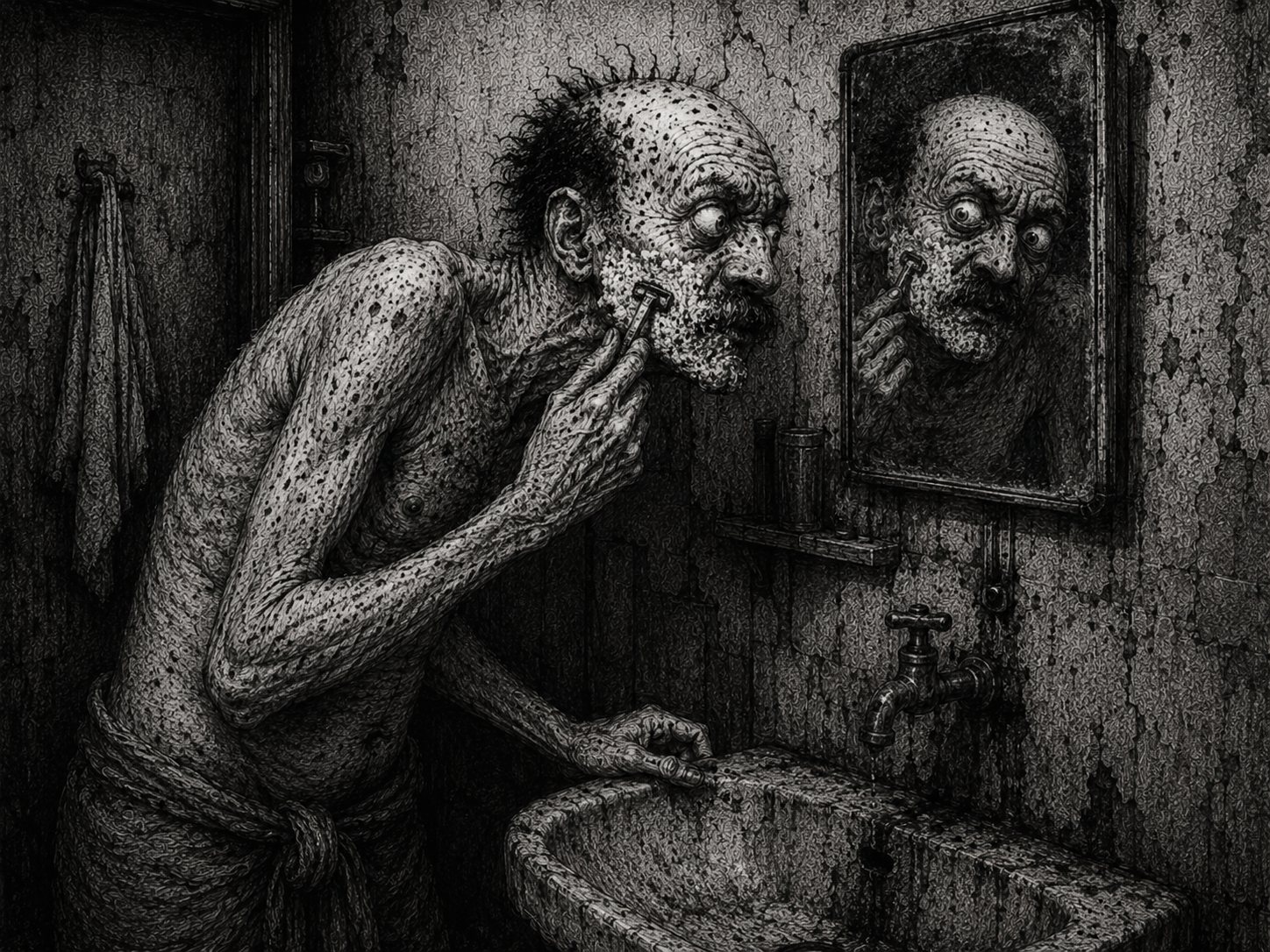
The bucket is not an object. It is an accusation with a handle.
There it sits in the bathroom, blue, plastic, half-full, slightly dusty, faintly oily around the rim, holding water with the smug patience of a retired headmaster. The mug floats inside it like a small boat that has seen too much. The towel hangs from the nail, damp, grayish, and morally superior. The mirror waits above the basin, not as a mirror exactly, but as a witness for the prosecution.
And I stand at the door.
Not entering.
Not leaving.
Just standing there in my South Calcutta room, one hand on the frame, one foot in civilization, the other in the swamp.
This is where cheerful people lose the plot.
They think bathing is a task.
Take bath, they say.
As if the matter is as simple as buying coriander from the vegetable seller, or switching on the fan, or forwarding one more fraudulent good-morning message with a rose and a sunrise and the emotional depth of a plastic stool.
But bathing is not a task when depression has entered the room and sat down heavily on the bed.
Bathing is a full-scale public works project.
It requires intention, sequencing, memory, towel planning, soap location, underwear diplomacy, skin tolerance, shaving negotiations, mirror confrontation, floor safety, water temperature, armpit realism, and the post-bath business of dressing like a participant in human society rather than a boiled potato who has read too much and owes money to people he avoids calling.
You think it is hygiene.
Actually, it is government.
And in depression the government has collapsed.
There is still a flag. There is still a building. There may even be a clerk somewhere under a pile of files. But the bridges are broken, the telephones are dead, the minister is missing, and one goat is eating the budget papers.
The bathroom becomes a border post.
On this side: mattress on the floor, fan, laptop, rice cooker, unpaid bills, one stale shirt smelling faintly of old sweat and fried onions, and the large invisible noise of being a fifty-one-year-old single Bengali man who once crossed oceans and now debates whether his towel has betrayed him.
On the other side: water, razor, soap, some chance of appearing in the world with the face of a man who has not completely resigned from the species.
Between the two stands executive function, that damaged little babu inside the skull, stamping papers slowly, losing files, saying, “Come tomorrow, sir,” while the armpit has already declared independence.
People call it laziness because people are confident in proportion to their ignorance.
They see the outside evidence: stubble, yesterday’s shirt, hair like defeated jute, stale mouth, oily forehead, one sandal near the bed and the other under a chair as if the feet themselves have separated after long incompatibility.
They do not see the inside.
Inside, the brain is trying to send a simple instruction—stand up, take towel, enter bathroom—but the message travels like a government letter during monsoon. It leaves one office, reaches another, gets wet, loses its envelope, acquires a tea stain, and finally arrives somewhere irrelevant where a man in a vest says, “Wrong department.”
The body knows what to do.
That is the insult.
I am not confused. I have not forgotten the cultural importance of soap. I am not waiting for a UNESCO certificate in bathing. Water exists. Soap exists. Razor exists. Skin exists, unfortunately. The information is present.
The bridge between knowing and doing is missing.
And from the other side of the river, some clean-collared philosopher is shouting, “Just cross.”
Just get up.
Just take a bath.
Just shave.
Just go outside.
Just keep a routine.
Just don’t think so much.
The word “just” is one of the great crimes of human speech. Small word. Large stupidity. It makes every collapsed bridge sound like a missing doormat.
To a healthy person, “take bath” is one line.
To a depressed mind, it opens like a court case.
First get up. Then find towel. Decide whether towel is usable or biologically ambitious. Find underwear. Decide whether underwear has crossed from garment into archaeological material. Locate soap. Decide whether shaving comes before or after bath. Face mirror. Inspect teeth. Regret teeth. Inspect belly. Regret belly. Notice neck. Regret neck. Notice hairline. Hold emergency meeting with the dead hopes of youth. Enter bathroom. Shut door. Avoid slipping. Pour water. Endure wetness. Clean the essential provinces. Rinse. Dry badly. Shave, maybe. Nick chin. Curse. Choose shirt. Smell shirt. Doubt shirt. Wear shirt anyway. Sit down. Sweat again.
By the time the plan has unfolded, the body has staged a coup.
Calcutta, naturally, contributes with civic enthusiasm.
The bathroom is small. The floor is always vaguely wet. The tap coughs like it has municipal asthma. The bucket has a soap ring. The mug looks permanently employed in disaster relief. Outside, the fan chops warm air into useless slices. Somebody’s pressure cooker whistles. Somebody’s child screams. Somebody’s television debates the nation into powder. A scooter in the lane coughs like a tuberculosis patient who has discovered percussion.
Heat changes morality.
In December, a man may imagine reform. He may think, from Monday I shall wake early, bathe properly, shave daily, eat sensibly, invoice clients, answer emails, walk a little, read Marcus Aurelius, and become a compact but respectable human unit.
In June, the same man becomes a moist amphibian with electricity anxiety.
The body begins to smell before the soul can defend it. The armpits develop a local movement. The groin becomes a humid republic. The scalp turns oily and resentful. The mouth tastes like a dead battery kept overnight in tea. All this would be comic if shame were not sitting nearby, rubbing its hands like a landlord who has remembered the rent.
Shame is not an idea.
Shame is a bodily organ. Almost. It has weight. It has weather. It sits in the throat, tightens the chest, gathers in the stomach like a municipal vat of rotten cabbage. It turns the towel into a witness, the mirror into a judge, the bucket into a blue plastic Supreme Court.
And depression adds the nastiest joke of all: the worse you feel, the more care you need, and the less able you are to perform the signs of being worth caring for.
This is especially bad for men after fifty.
A young sad person may still look poetic under certain lighting. A woman, unfairly burdened in other ways, may sometimes be read as tragic, fragile, wounded, overworked, exhausted. But a balding, unshaved, thickened, anxious, lower-middle-class man of fifty-one, wearing a tired T-shirt and smelling faintly of heat and defeat, is not read as wounded.
He is read as failed.
Careless.
Suspicious.
Expired.
Public nuisance in human form.
So you hide.
You become an indoor rumor.
You hear the vegetable seller downstairs. You hear the gas-cylinder man dragging metal like a minor war. You hear schoolchildren with bags bigger than their torsos. You hear the fish seller shouting prices as if announcing troop movements. You hear a delivery boy call someone “sir” with the tired politeness of a man who has already been insulted twice before lunch.
The city is moving.
You are not.
That is the wound.
People write easily about heartbreak, exile, capitalism, elections, cricket, Tagore, Ray, Stalin, Silicon Valley, artificial intelligence, bad roads, good tea, and the eternal Bengali argument over whether the fish was properly cooked.
It is harder to write this sentence:
I could not bathe today.
Harder still:
I could smell myself and still could not move.
That is a private defeat below literature, below politics, below philosophy. It happens at the bathroom door, quietly, without a newspaper headline. Civilization does not first collapse in Parliament. It collapses when the towel is two steps away and the hand will not reach.
There is history here too, because there is always history, even in a bucket.
The British arrived with ledgers, rifles, railways, clubs, cholera theories, and that remarkable imperial talent for turning theft into paperwork. They were obsessed with cleanliness in the way ruling classes often are, because hygiene is never only hygiene. It is hierarchy wearing soap.
The clean sahib. The dirty native. The club bathroom. The servants’ quarters. The polished shoe. The shaved face. The correct collar. Soap became not merely soap but a certificate of moral worth.
Then we inherited the nonsense in local packaging.
Clean shirt means decent man. Polished shoe means discipline. Shaved face means employable. Perfume means success. Anyone who smells even faintly of human animal is pushed toward the social drain.
But depression does not respect empires.
Depression is anti-colonial in the worst possible way. It frees you from the oppressor and then forgets to build drains.
Shaving has its own courtroom.
The mirror above the basin does not show a face. It shows evidence.
White stubble. Loose skin. Nose hair like insurgent grass. A tooth darkening like a small political scandal. A chin that has lost its argument with gravity. Eyes that do not look wise, tragic, romantic, dangerous, or deep. Just under-maintained.
Like a government office corridor at 3 p.m.
You put foam, or soap, or nothing because economy has become philosophy, and drag the razor over the face. Every stroke says: here is the man you failed to become. Here is the man you are still pretending to repair. Here is the man who once went to the US, wrote code, handled data, read papers, spoke in meetings, crossed oceans, survived airports, winters, supervisors, rent, loneliness, and American bread, and now stands in a Calcutta bathroom deciding whether one old T-shirt is less offensive than another.
Life has a comic timing so cruel that even a professional comedian would reject it as too obvious.
Dressing is worse.
Bathing at least has the honest animal relief of water. Dressing is social fiction.
Clothes are lies folded in cotton.
A clean shirt says: I intend to participate.
Trousers say: I may leave the room.
Underwear says: I have not fully joined the forest.
Shoes say: the ground and I have reached a legal understanding.
Depression hates all this costuming because it knows too much. It knows the meeting may not happen, the client may not call, the invoice may not be paid, the friend may not reply, the world may not require your attendance, and yet still you must dress because smell is democratic but judgment is not.
Meanwhile the news performs its circus.
Some leader has said something. Some channel is shouting. Some app wants an update. Some billionaire is building a machine to improve humanity while my own fan cannot improve the air above my head. Somewhere a rocket rises. Somewhere a stock falls. Somewhere a committee announces a scheme. And here in the southern fringe of Calcutta, a man is trying to decide whether he can tolerate the feeling of water on his back.
This is not a small problem.
It only looks small because the objects are small.
Bucket.
Towel.
Razor.
Soap.
Shirt.
But small objects are where life keeps its real accounts. The empire of the day is hidden in the mug. The biography is folded into the towel. The whole trial of being alive is conducted before a cracked mirror above a basin with one stubborn stain.
Sometimes I do bathe.
Let us not make it noble.
There is no violin music. No rebirth. No montage. I do not emerge like a hero from a river at sunrise. I pour water on my head and gasp like a piglet being baptized against its will. I soap the important districts. I shave badly. I nick the chin. I curse with feeling. I dry myself in patches. I put on a shirt that is almost clean if judged by medieval standards.
Then I sit on the bed under the fan.
Already sweating again.
For twenty-three minutes I smell of Lifebuoy and temporary citizenship.
Then the old republic begins returning from the armpits.
The bucket sits quietly behind the bathroom door, filling with its little pond of accusation. The towel begins its slow damp betrayal. The razor waits for tomorrow’s evidence. The shirt takes notes.
And I, manager, clerk, peon, debtor, and unpaid watchman of my own skull, sit in the heat and understand something both ridiculous and serious: civilization is not a grand monument. It is not marble, flag, anthem, constitution, conference, or slogan.
Sometimes civilization is only this.
A man standing at a bathroom door.
A bucket of water.
A body he has not forgiven.
And the tiny, stubborn decision to try again before the day rots completely.